
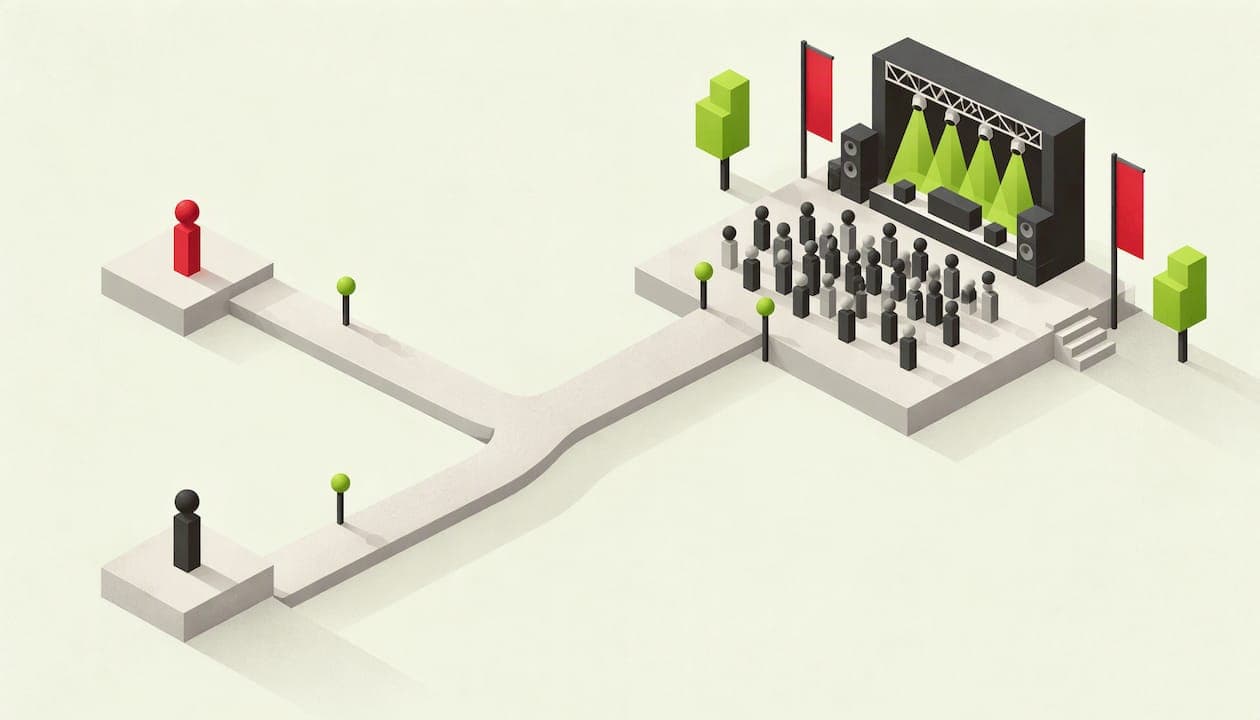
The fastest way to find a concert buddy is to look where fans of that artist already gather in your city: local interest groups, city forums, fan communities, and the line outside the venue. Post a few days before the show with the artist, venue, date and a little about you, meet in a public place first, and keep your own ride home. This guide walks through each step, from the first message to the last train.
TL;DR
- Search for local concert groups and fan communities in your city, then post a few days before the show with the artist, venue, date and a short intro.
- Combine the artist name, your city and a word like "fans" or "pre-show meetup" to find the small local groups that big search results bury.
- No account needed? Strike up a conversation with fans in line. Questions about the opener or past shows are an easy start.
- Agree on the basics early: who has the ticket, where you meet, when you leave, and how you split costs.
- Meet in public first, share your plans with a friend, and use your own transport.
Table of Contents
- Where to find a concert buddy in your city
- Search phrases that surface local fans
- How to write the post that gets a reply
- No sign-up? Find a buddy at the venue
- What to agree on before the night
- Meeting someone new safely
- Tickets, arrival and getting home together
- Our perspective: spontaneous beats scheduled
- Find people nearby with Bump
- More ways to meet people around the show
- FAQ
- Sources
Where to find a concert buddy in your city
A concert buddy is rarely found by luck. It is found by showing up in the places where people who love the same music already talk to each other. Three kinds of places do most of the work.
Local interest groups
Group-based event sites let you search for something like "your city concerts" or "your city live music" and join a group whose organizer posts upcoming shows. Members RSVP and attend together. According to ConcertsRemembered, nearly 476,000 people belong to concert-related groups of this kind worldwide, with active groups in cities such as New York, Los Angeles, Chicago, Washington DC and Seattle. That figure comes from a blog rather than a census, so treat it as a sense of scale, not a precise count.
The pages that rank for this keyword in the US look the same from city to city: Baltimore, Tampa, Portland, Bellevue, St. Louis, Jacksonville, Chandler. Each is a directory of local groups and events. They show how widely this works, and they also show what to expect: groups are organized by metro area, so the more specific your search, the better.
City forums and message boards
Most large cities have an active forum or community board, and many have a thread for concerts. A short post works better than a long one. Say which show, which venue, which date, and one or two sentences about you. The same guide recommends checking the person's post history before you agree to meet anyone, which is good advice in both directions: expect people to look at yours too, so keep your profile honest.
Artist and genre fan communities
Fans of almost every artist organize on social platforms, chat servers and group pages. These communities are often the best match because everyone already likes the same thing. Look for a city or regional channel inside the larger community, because the national one is usually too big to arrange anything.
Search phrases that surface local fans
Fandom tends to be organized by city, metro area, campus or venue rather than by one giant public group. The Kings Live suggests combining the pieces in a search, for example:
- artist name + your city + fans
- artist name + listening party + your city
- venue name + pre-show meetup
Try each one on a general search engine, then again inside the community platforms you use. A pre-show meetup at a bar near the venue is a gentle way to meet several people at once, which takes the pressure off a one-to-one first meeting.
Two more variations help. Search the opener's name, since fans of a supporting act are often just as keen to find company. And search the venue plus "tonight" or "this weekend" if you are looking for something spontaneous.
How to tell a healthy group from a dead one
Before you join a group in earnest, The Kings Live lists the signs of a community worth your time:
- Recent activity, not long silent gaps
- Clear event details: time, place and what to expect
- Moderation or community guidelines
- Members who talk to each other like real people
- Photos or recaps from past meetups
- No pressure to pay unofficial fees or send money privately
That last point matters most. A real concert buddy never needs you to wire money, pay a stranger "for the ticket" through a private app, or cover someone's entry in advance.
How to write the post that gets a reply
The research on this is simple: post a few days before the show, not the afternoon of. People need time to say yes, check your profile and rearrange their evening. A good post has five parts.
- The show: artist, venue, city and date.
- Your seat situation: you already have a ticket, or you are buying one and want to coordinate.
- A bit about you: how long you have been a fan, what you are hoping for (singing along, standing near the front, a quiet seat).
- The plan: a pre-show meetup spot in public, if you want one.
- The ask: one clear sentence, such as "Looking for one or two people to go with."
Keep personal details light. Do not lead with your exact schedule, where you are staying or the fact that you are traveling alone. A reported thread about women meeting up at Lollapalooza produced exactly that advice: skip vulnerable details at first, prefer public spaces over sharing lodging with strangers, and be wary of anyone who asks for money.
No sign-up? Find a buddy at the venue
You do not need an account to meet someone at a show. The simplest option is to go alone and start low-pressure conversations. The First Concert Checklist points out that the concert itself gives you easy openers: the artist, the opener, the venue, or whether the person next to you has seen the act live before.
A few ways to make that work:
- Arrive early. The line outside is full of people with nothing to do but talk about the show.
- Ask a question, not a pitch. "Have you seen them before?" beats "Want to be my concert buddy?"
- Go to a public fan meetup if one exists for the show. Organizers often post these in advance in local groups.
- Stay in public places and keep your own transport, as the same checklist recommends.
This route will not always give you a friend for life, but it often gives you someone to watch the set with, and sometimes someone to go to the next show with.
Do free options really cost nothing?
Mostly, yes. ConcertsRemembered notes that most concert-buddy options are free: group sites are free for members (organizers pay), forums and chat servers are free, and where there is a paid tier it is usually a premium feature, not access to basic matching. If a service asks you to pay before you can talk to a single person, look elsewhere.
What to agree on before the night
A stranger who seems perfect in messages can turn out to be a poor fit on the day if nobody said the practical things out loud. Settle these before you meet. Short messages are fine.
| Topic | What to settle |
|---|---|
| Tickets | Who holds each ticket, whether you buy together or separately, and whether anyone needs a transfer |
| Meeting point | A specific public spot near the venue and a time, plus a backup if someone is late |
| Standing or seated | Whether you want to be near the front or near the back, and what happens if you want different things |
| Staying together | Do you stay side by side all night, or is it fine to drift and meet again after the set? |
| Money | How you split drinks, food, parking or rides, and whether you pay each other back in person |
| Leaving | When you leave, whether you stay for the encore, and how each of you gets home |
| Phones | Whether you will keep a charged phone and share a number in case you get separated |
The point is not to draw up a contract. It is to avoid the awkward moment at 10:45 p.m. when one person wants to beat the traffic and the other wants every last song. If you have different styles, say so. Two people who both say "I like to stay close to the stage" will have a better night than two who guessed.
A useful rule: agree on a regroup spot. The Florida Sheriffs Association recommends a buddy system and naming a landmark or vendor where you meet if you get separated.
Meeting someone new safely
Most concert buddies turn out to be exactly what they seem: another fan. A few habits keep that likely and keep you comfortable if it is not.
Before you meet
The Irish police service's online safety advice is a sound checklist for any first meeting with someone you met online, wherever you live. It suggests asking for a recent face picture or a live video call, checking the person's social media, telling a trusted person where you are going, sharing your live location, and meeting in public first.
For a concert, that translates into:
- A short video call a day or two before. Five minutes is enough.
- A quick look at their public profiles. Do the photos and the story match?
- A message to a friend with the artist, venue, time and the person's name.
- Live location sharing switched on for the evening.
The first meeting
Pick a busy public place, such as a café, food hall or the plaza outside the venue. Avoid meeting first at a home, in a car or somewhere quiet. Arrive and leave with your own transport, set a check-in time with a friend, and keep the first meeting short so either of you can leave without awkwardness. These are the recommendations of Chatix, a safety checklist for meeting online friends.

Inside the crowd
The Florida Sheriffs Association also advises staying hydrated, limiting substance use and moving away from dense or chaotic crowds. And be careful with drinks: the Irish police guidance says to think carefully before accepting food or drink from someone you have just met. Buy your own, and keep it in your hand.
If something feels off at any point, you can leave. A ticket is not an obligation to stay with anyone.
Tickets, arrival and getting home together
Logistics are where good plans quietly fall apart. Go through them one at a time.
Check the official listing. The venue or event page lists the date, doors time, show time, entry rules and ticket-transfer conditions. The First Concert Checklist notes that doors and show times may differ and that tickets may be mobile-only or tied to an account, which matters if you plan to buy for two and hand one over.
Pick a meeting time before doors. Give yourselves a buffer for security lines. If you are meeting for a pre-show bite, choose somewhere within walking distance and set a hard leave time.
Plan the trip home before the encore. New York City's nightlife safety guidance advises planning a safe journey home and never leaving with a stranger without telling someone you know. In practice: decide who is taking which train, ride or car, and text your friend when you are back.

Keep your phone charged. A map, a ticket and a way to reach your buddy all live on it. Bring a small battery pack.
Our perspective: spontaneous beats scheduled
Most of the advice online assumes you plan weeks ahead, join a group, wait for approval and slowly build a rapport. That works for some people. It does not help when you find out on Thursday that a band you love is playing Friday and nobody in your circle is free.
We built Bump for that moment. You should be able to find who you want, when you want and where you want, without a long registration process and without paying a fee to start. The core experience is free, and that is deliberate: meeting people should not begin with a form.
What we have learned is that the tools matter less than the habits. Be clear about the plan, meet in public, tell someone where you are, and keep the first meeting short. Do those four things and you can say yes to spontaneous plans with much more confidence.
If you are new to a city, traveling, or simply done waiting for the right group to come along, location-based search and direct messaging make it quick to find people nearby and arrange to meet.
the author
Find people nearby with Bump
If you want to move faster than a group calendar allows, Bump lets you search for people and places by location, message directly to arrange a meetup, and skip the sign-up and fees. You can start on Bump and look around your area, or browse the categories on the search page to see what is near you.

Bump also works well beyond concerts, for a coffee before the show, a walk after it, or finding company in a city you do not know yet.
More ways to meet people around the show
A concert buddy can lead to more than one night out. These guides cover the wider picture:
- Short on time? Read how to meet people tonight in fast, safe ways.
- Just moved? Making friends in a new city takes a step-by-step approach.
- On the road? Try these ways to meet people while traveling, many of which suit a night at a local venue.
- Prefer a clear head? See socializing without alcohol, which fits shows where drinking is not the point.
- Find crowds draining? Introvert friendships explains how to build close friendships at your own pace.
FAQ
How do I find someone to go to a concert with if I do not know anyone?
Join a local concert or live music group, post in a city forum, or find the artist's fan community and look for your city's channel. Post a few days ahead with the artist, venue, date and a short intro. You can also simply talk to fans in line at the venue, which needs no account at all.
Is it safe to go to a concert with someone I met online?
It can be, if you take sensible steps. Do a short video call, check their social media, tell a friend where you are going, share your live location and meet in a public place first. Use your own transport, and think carefully before accepting food or drink from someone new.
Can I find a concert buddy without paying or signing up?
Yes. Most group sites, forums and fan communities are free to join, and paid tiers are usually extras rather than the price of basic matching. You can also meet people in person at the venue. On Bump, searching and connecting is free and does not require registration.
What should I do if my concert buddy cancels?
Go anyway if you feel comfortable, or post in the show's local group asking if anyone wants a spare ticket partner. If the show has a pre-show meetup, join it. Check your ticket's transfer rules first so you know your options.
What should I say to start a conversation at a show?
Ask something about the music: whether they have seen the artist before, what song they hope to hear, or what they think of the opener. These questions are easy to answer and need no introduction.
Sources
- How to Find Concert Buddies: A Realistic Guide for 2026 (ConcertsRemembered)
- How to Find Local Music Fans for Meetups (The Kings Live)
- First Concert Checklist: What to Bring and Expect
- Safety Advice for Meeting People Online (Garda)
- How to Stay Safe at Crowded Events (Florida Sheriffs Association)
- Reddit thread raises safety concerns over young women meeting up at Lollapalooza (Extra Chill)
- Meeting an Online Friend in Person: The Safety Checklist (Chatix)
- Nightlife Party Safety Tips (NYC)