
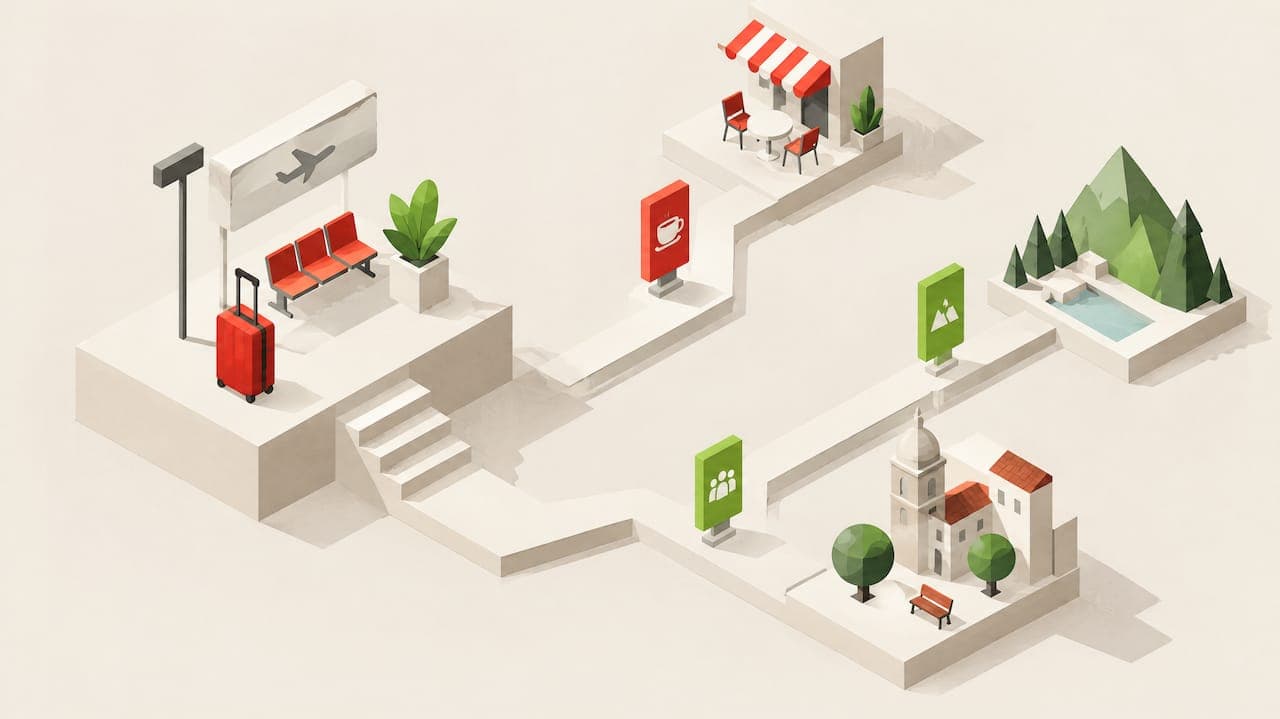
The easiest way to meet people while traveling is to put yourself in places where talking is normal: social hostels, walking tours, classes, group meals and local events. Then make the first move with a small, low-pressure question. Apps and online groups help you skip the guesswork, as long as they end in a real meeting in a public place. This guide covers where to go, what to say, how to meet locals respectfully, what to look for in an app, and how to stay safe.
TL;DR
- Pick settings where conversation is expected: social accommodation, small-group and free walking tours, classes, shared tables.
- Open with the shared situation ("First time here?"), ask one follow-up, and suggest one small next step.
- Online groups and apps are most useful when they lead to a concrete offline plan, such as a language exchange, a show or a coffee.
- Look for apps that are quick to use, show people near you, and let you message directly. Bump needs no registration and no fees.
- First meetings belong in public places. Tell someone where you are going and keep your own way home.
Table of Contents
- Why meeting people on the road is harder than it looks
- Choose accommodation that does some of the work
- Join something with a group built in
- Use online groups and traveler networks
- Look for spontaneous options when plans change
- How to start a conversation (and keep it going)
- How to meet locals respectfully
- Staying safe when you meet someone new
- Our perspective
- Try Bump on your next trip
- A simple plan for your first 48 hours in a new city
- Common mistakes to avoid
- FAQ
- Sources
Why meeting people on the road is harder than it looks
On a trip you have the opposite of your home routine. You have free time and curiosity, but no workplace, no neighbors and no shared friends to make introductions. People who are traveling with a partner or a group are often busy with each other. Locals are going about their day.
The fix is not to become a different person. It is to choose the right setting, because the setting does much of the social work. A solo traveler at a cooking class has a built-in topic. A solo traveler on a park bench has to invent one.
Here is how to do that, starting with the places where it is easiest.
Choose accommodation that does some of the work
Where you sleep decides how many casual conversations you will have. Lonely Planet notes that hostels often run social event calendars, and that some hotels host pool parties, workout classes and other activities. Check the activity schedule before you book, not after.
Smaller places work too. Rick Steves points out that hostels, small pensions and B&Bs are good for meeting people, and that pension and B&B owners and other guests often have time to talk over breakfast.
A few practical choices:
- Dorm or private room in a hostel. You can take a private room and still use the common area, the bar and the group dinners.
- A guesthouse with a shared breakfast table. One host can introduce you to the whole neighborhood.
- A hotel with scheduled activities. Useful when you want privacy at night and company by day.
When you are staying anywhere, do not announce your room number or tell every stranger you are alone. SmarterTravel suggests keeping room numbers private and not volunteering that you are traveling solo if someone pushy asks.
Join something with a group built in
Shared activities give you something to talk about and a natural end point. Rick Steves lists group walking tours, food tours, cooking classes, sports events and excursions as social experiences for solo travelers.
Walking tours, food tours and day trips
Free walking tours and small-group tours are the classic first-day move. You spend two or three hours walking at the same pace as ten strangers, and someone will ask where you are from within the first fifteen minutes. If you click with someone, suggest lunch after the tour. You already have a reason to stay together.

Classes and workshops
KAYAK recommends classes such as surfing, cooking, dancing or language lessons, because a shared skill in a local setting gives solo travelers an easy basis for conversation. Pick one that runs over several hours or several days. A single hour is too short to turn into a friendship.

Everyday places
Rick Steves also names buses, trains, tourist sights and laundromats as places to meet people, and suggests that a camera or a deck of cards can start conversations. Offering to take someone's photo at a viewpoint is one of the lowest-effort openers there is.
Use online groups and traveler networks
Online tools work best as a bridge to something in person. Euronews describes how expat and traveler groups led to language exchanges, meetups with locals and other travelers, music venues, flamenco shows and local events. The groups were the doorway, and the offline activity was the point.
KAYAK describes several types of network that support this: hospitality-exchange communities with local meetups, traveler groups for people in the same city, and event platforms where you can browse what is on during your dates.
How to use them without wasting time:
- Join a city group a week before you arrive.
- Post once with your dates and what you want to do, not just "anyone around?"
- Say yes to the first public event that fits your schedule.
- Skip long chat threads. Propose a time and place within a few messages.
Look for spontaneous options when plans change
Planned events do not cover every evening. Sometimes you land in a city on a Tuesday night, the group event is on Friday, and you want company now. That is where real-time, location-based tools help.
What to look for in an app for meeting people on the road
When you compare options, these criteria matter more than a long feature list:
| Criterion | Why it matters on a trip |
|---|---|
| Setup time | You may have only a few free hours. Long profiles and verification steps slow you down. |
| Location search | You need people near where you are, not across the country. |
| Direct messaging | Short messages let you settle time and place quickly. |
| Cost | Paywalls before you can message anyone are frustrating when your stay is short. |
| Language support | Menus and messages in your language reduce misunderstandings abroad. |
| Privacy | Fewer personal details collected means less to worry about when you travel. |
One more thing to weigh is purpose. Some tools are built for finding fellow backpackers. Others are built for dating. Others are built for finding company of many kinds, from a drink to a night out. Know which one you want before you open it.
Where Bump fits
Bump is designed for exactly the "now" situation. You search by location, see who is available, and message directly to arrange a meeting. There is no registration and no fee for the basic experience, and the interface comes in several languages. Our categories include Travel companion, Clubs, Hotels, Massage and more, so you can pick the kind of company you are looking for. These are adult services, so use them only if you are an adult and only where they are legal. Rules differ widely between countries and cities, so check local law before you go.
If you want a plain public coffee or a walking-tour friend, the other ways in this guide are a better match. If you want something spontaneous, in your language and without an account, Bump is built for that.
How to start a conversation (and keep it going)
Most travelers want to talk. Most are waiting for someone else to start. Here is a simple method.
Pick the right moment
The ibis Magazine from Accor recommends approaching people who are unhurried: someone sitting, waiting, browsing or ordering. Skip people with headphones in or who are rushing.
Open with the situation
The same source suggests a low-pressure question such as asking whether it is their first time in town and what their favorite thing has been so far, then asking one simple follow-up and leaving a graceful exit. That last part matters. People relax when they know they can walk away.
A five-step flow
SoloEra suggests a first conversation with five moves:
- Notice something you share.
- Ask an open question.
- Share something about yourself.
- Follow an interesting thread.
- Suggest a small next step if the interaction feels mutual.
The small next step is what turns a chat into a connection. "I'm heading to the market, want to come?" is easy to accept. "Let's travel together for two weeks" is not.
Turning a good chat into a friendship
The British Council recommends open-ended questions, enthusiastic follow-ups and finding shared interests. If you want to stay in touch, say so directly and exchange contact details. A friendship while traveling often lasts through messages and one reunion trip, and that is fine.
How to meet locals respectfully
Meeting other travelers is easy. Meeting locals takes a bit more care, and it starts with a mindset: locals do not owe you conversation or a cultural experience. Exploring Wild makes this point: read interest, avoid pressure, and balance curiosity with common sense.
What works in practice:
- Use the local greeting and a few polite phrases. Backpacking Diplomacy recommends starting with a greeting and polite phrases, then using translation tools or gestures when needed.
- Confirm the details. Repeat or write down the time, price and place so nothing is lost in translation.
- Keep your language simple. The British Council advises casual language and active listening. Connection matters more than perfect grammar.
- Go where locals already go. Language exchanges, local classes, community sports and neighborhood cafés beat tourist squares.
- Be a good guest. If someone invites you home or to a family event, bring a small gift, follow their lead and do not overstay.
If you are trying to find people through an app, say what you are looking for in your first message. It saves everyone's time and makes it easier for people to say yes or no.
Staying safe when you meet someone new
Most first meetings are uneventful. A few habits keep them that way. These come from the SoloEra guide and Exploring Wild, and they match the general advice from the U.S. State Department quoted by SmarterTravel.
- Meet first in a public place. A café, a market or a hotel lobby, not a private home.
- Tell someone where you are going. A friend, a hostel staff member or a family member back home.
- Keep your own way home. Know the bus, the metro or the taxi app before you go.
- Limit alcohol. It is easier to read a situation when you are sober.
- Leave if anything feels wrong. You do not need to give a reason.
- Do not share your exact accommodation early. Stay vague until you trust the person.
- Do not send money or deposits to someone you have not met.
If an invitation comes with context, such as a host, a group or a venue, it is usually more trustworthy. If it comes from nowhere and pushes you to move fast or go somewhere private, slow down. If you ever feel unsafe, move to a crowded place and ask staff for help. In an emergency, call the local emergency number and contact your country's embassy or consulate.
Our perspective
We built Bump around one observation: when you travel, time is short and friction costs you. A long sign-up, a paywall before the first message, a profile that needs three photos, all of this eats into the evening you are trying to enjoy. So we kept the basics simple: search by location, see who is around, message directly, and no registration or fees to get started.
We also think honesty beats hype. An app cannot make you friends. It can shorten the distance between wanting company and having a plan for tonight. Pair it with the habits above: choose public places, be clear about what you want, and treat everyone you meet, local or traveler, with respect.
And know what kind of connection you are after. For some trips that is a walking-tour buddy. For others it is a drink, a night out, a travel companion or something more private between consenting adults. Both are valid, and they need different tools. We offer categories for the latter, and we would rather you pick the right tool than a poor fit.
— the author
Try Bump on your next trip
If you are arriving somewhere new and want company without creating an account, open Bump and search by location. You can browse categories such as Travel companion, Clubs and Hotels on the search page and message directly to settle the time and place. Our basic features are free, and the interface is available in several languages.

If you run a venue, service or listing and want to be seen by travelers nearby, advertising space is available on the site. Details are on the Bump homepage.
A simple plan for your first 48 hours in a new city
To pull this together, here is a plan you can copy for a short trip.

Before you leave. Join one local group online and check hostel or hotel event calendars. Pick a class or tour for day one.
Day one, morning. Take a free walking tour or a small-group tour. Ask one person a question about the place, not about themselves.
Day one, evening. Eat at a shared table, a hostel kitchen or a bar counter. If you are alone with nothing planned, use a real-time tool to find company nearby, and keep the first meeting public.
Day two. Do something with a skill in it: cooking, surfing, dancing, a language exchange. Propose lunch or a drink to anyone you click with.
Day two, evening. Ask the people you met if they want to do the "one thing" in town. Having a plan makes it easier to say yes.
By the end of two days you will have talked to a dozen people and made at least one real connection. It rarely takes more than that.
Common mistakes to avoid
- Waiting to be approached. Most people are waiting too.
- Opening with a big ask. Start with a small one.
- Only using screens. Online groups pay off when they become offline plans.
- Ignoring your gut. If a situation feels off, leave.
- Treating locals as a tour attraction. Be curious, but let them set the pace.
- Over-planning. Leave evenings open so you can say yes to something unexpected.
FAQ
What is the easiest way to meet people while traveling alone?
Stay somewhere social, such as a hostel with an event calendar or a guesthouse with a shared breakfast, and join a group tour or class on day one. Those settings give you a built-in topic and a group of people who also want to talk. After that, one friendly question is usually enough.
How do I meet locals if I do not speak the language?
Learn a greeting and a few polite phrases, and use a translation tool or gestures when you get stuck. Write down or repeat key details such as time, place and price. Language exchanges and classes are especially good, because everyone there wants to practice.
Is there an app to meet people while traveling without signing up?
Yes. Bump lets you search by location and message directly without registering, and the basic experience is free. It includes adult categories, so use it only if you are an adult and where those services are legal. For a more general social meetup, group tours and local events are also good options.
How do I stay safe meeting someone I just met online?
Meet in a public place, tell someone where you are going, arrange your own way home and keep alcohol low. Do not share your exact accommodation early and never send money in advance. If something feels wrong, leave and ask staff at a nearby venue for help.
How do I turn a travel acquaintance into a friend?
Suggest a small, casual next step, like lunch or a walk, and exchange contact details if you want to stay in touch. Keep following up with a message about something you talked about. Shared interests are what keep a friendship going after the trip.
Sources
- The Solo Traveler's Hack to Making Friends, Lonely Planet
- Tips for Traveling Solo, Rick Steves
- 6 ways to meet people when travelling solo, KAYAK
- Solo travel doesn't have to be lonely, Euronews
- How to find friends while travelling, ibis Magazine
- How to Meet People While Traveling Solo: 12 Ways, SoloEra
- Essential conversational English phrases for making friends abroad, British Council
- How to Handle a Language Barrier, Backpacking Diplomacy
- How to Meet Locals While Traveling, Exploring Wild
- 10 Important Safety Tips for Solo Travelers, SmarterTravel